E-mail: sachikoo_sz@yeah.net
Telephone: +86-13118819569

Views: 0 Author: Site Editor Publish Time: 2026-08-11 Origin: Site


Guest satisfaction and sleep quality correlate directly with room acoustics. Mechanical noise from in-room appliances remains a leading cause of negative post-stay reviews. Hoteliers and facility engineers face a strict balancing act. You must provide reliable in-room refrigeration while adhering to stringent acoustic limits. You also manage energy consumption, cabinet ventilation constraints, and long-term maintenance demands. Compressor-based units offer rapid cooling but introduce unacceptable mechanical noise. This guide evaluates the absorption mini fridge as the industry standard for 0dB operation. We detail the engineering realities, essential features, and implementation requirements for hospitality environments. We will examine how these units integrate into custom cabinetry without overheating. You will learn the exact ventilation clearances required to prevent system failure. We also cover the differences between solid and glass configurations to help you optimize minibar merchandising without compromising thermal efficiency.
Acoustic Superiority: Absorption cooling utilizes a heat-driven thermochemical cycle with zero moving parts, achieving verifiable 0dB (completely silent) operation that complements high-end room soundproofing.
Technology Trade-offs: While silent, absorption units require strict adherence to cabinet ventilation guidelines and generally consume more energy than compressor models to achieve the same internal temperatures.
Design vs. Efficiency: Selecting a glass door mini fridge increases merchandising visibility for minibar revenue but requires higher energy expenditure compared to solid-door models due to thermal insulation differences.
Lifespan: The absence of a mechanical compressor significantly extends the operational lifespan of absorption units, often offsetting the higher initial procurement cost and energy usage over a 7-to-10-year lifecycle.
Absorption refrigeration eliminates the mechanical compressor entirely. The system relies on a continuous thermochemical cycle using three specific substances. We use ammonia as the refrigerant, water as the absorbent, and hydrogen gas as the pressure equalizer. An electric heating element boils the ammonia-water solution in the generator. The ammonia gas rises through a percolator tube, separates from the water, and travels to the condenser fins located at the rear of the unit.
As ambient room air cools these fins, the ammonia gas condenses into a liquid state. This liquid flows downward into the evaporator inside the cabinet interior. Here, it mixes with hydrogen gas. The sudden drop in partial pressure causes the liquid ammonia to evaporate rapidly. This phase change absorbs heat from the interior cabinet, cooling the stored contents.
The heavy ammonia-hydrogen gas mixture then sinks back down to the absorber vessel. Water from the generator reabsorbs the ammonia, releasing the hydrogen gas back up to the evaporator. This continuous, gravity-fed loop operates without any motors, fans, or moving parts. The result is true 0dB operation. You eliminate vibration, motor cycling, and distracting hums entirely. Because the system relies heavily on gravity to return the liquid ammonia to the boiler, the unit must sit perfectly level. Even a slight tilt can pool the refrigerant in the tubing, halting the cooling process and requiring a manual reset of the unit by inverting it.
Facility managers often compare absorption units with solid-state alternatives. A semiconductor mini fridge utilizes the Peltier effect. Direct electric current passes through two dissimilar conductive materials. This transfers heat from one side of the device to the other, creating a solid-state heat pump.
While both technologies operate silently, their performance profiles differ significantly in the field. Absorption systems typically outperform semiconductor models in overall cooling capacity, especially in higher ambient temperatures. Semiconductor units struggle to maintain safe food storage temperatures if the room gets excessively warm. If the room HVAC shuts off during the day, a Peltier unit might let the internal cabinet temperature rise above safe beverage thresholds.
Furthermore, Peltier modules experience thermal degradation over time. The constant heating and cooling stress the conductive materials. Hermetically sealed absorption systems maintain consistent cooling efficiency throughout their operational life, provided the internal steel tubing remains intact and free from corrosion.
Cooling Technology Performance Comparison
| Technology Type | Noise Output | Cooling Mechanism | Ambient Heat Tolerance | Expected Lifespan |
|---|---|---|---|---|
| Absorption | 0dB | Ammonia/Water Cycle | High (up to 32°C/90°F) | 7-10+ Years |
| Semiconductor | 0dB | Peltier Effect | Low (up to 25°C/77°F) | 3-5 Years |
| Compressor | 35-45dB | Mechanical Motor | Very High (up to 38°C/100°F) | 5-8 Years |
Traditional compressors use a motorized pump to compress refrigerant gas. This mechanical action generates significant noise, typically ranging between 35 and 45 decibels. In a quiet hotel room at night, the sudden kick-on of a compressor disrupts sleep architecture. Guests notice the vibration transferring through the cabinetry. Absorption units operate at 0dB, preserving the acoustic integrity of the room.
The primary trade-off is pull-down time. Compressors forcefully move refrigerant, allowing them to cool a warm cabinet in under an hour. Absorption systems rely on passive heat transfer and gravity. They require several hours to reach target temperatures from a warm ambient state. You must account for this during initial installation and deep-cleaning turnarounds. When housekeeping unplugs a unit to defrost or clean it, it will not provide immediate cooling for the next guest. We recommend keeping spare, pre-chilled units in the maintenance bay for rapid swap-outs if a guest requests immediate refrigeration.
Selecting the right hotel mini fridge requires looking beyond the cooling mechanism. Operational efficiency dictates specific feature requirements for your property. Auto-defrost functionality is non-negotiable. It prevents ice buildup on the evaporator plate, reducing housekeeping maintenance and ensuring consistent cooling performance. Without auto-defrost, ice acts as an insulator, forcing the heating element to run continuously and wasting energy.
Interior LED lighting provides premium guest presentation. LEDs emit negligible heat, protecting the internal thermal balance of the cabinet. You should specify adjustable shelving to accommodate varying bottle sizes, from tall sparkling water bottles to small minibar snacks. Fixed shelves limit your merchandising options.
Integrated lock-and-key systems remain essential for properties managing controlled minibar inventory or securing restricted items. Even if you do not currently charge for minibar items, having the physical lock allows you to pivot your beverage strategy in the future without replacing the hardware.
Luxury accommodations invest heavily in architectural soundproofing. Thick drywall, solid core doors, and acoustic window glazing lower the ambient room noise floor. In these environments, even minor mechanical noises become highly perceptible. A compressor cycling on at 40dB shatters the quietness of a heavily soundproofed suite.
Deploying a 0dB appliance maximizes the return on your architectural soundproofing investments. It ensures that the engineered silence of the room remains uninterrupted by operational equipment. Mid-scale properties with higher ambient noise floors, such as urban locations with street noise, might tolerate slight hums. However, 0dB operation universally enhances guest comfort. We frequently see properties upgrade their windows to block highway noise, only to receive complaints about the refrigerator buzzing. You must treat the room as a complete acoustic ecosystem.
Absorption technology operates on a delta-T, or temperature difference, principle. The internal cabinet temperature depends directly on the external ambient room temperature. A high-quality absorption unit typically achieves a delta-T of 20°C to 25°C. If the hotel room sits at 22°C (71°F), the fridge easily maintains a 4°C (39°F) internal temperature.
Performance limitations emerge in non-climate-controlled environments. If a property in a tropical region powers down room HVAC systems between guest stays, ambient temperatures can spike. The absorption unit will struggle to maintain safe cooling levels under extreme ambient heat. You must align your HVAC setback policies with the appliance operational thresholds. If your energy management system lets the room reach 30°C (86°F) during the day, the internal fridge temperature will likely rise above 10°C (50°F), spoiling milk or sensitive food items.
The continuous heating element in an absorption system draws steady electrical current. Consequently, these units consume more kilowatt-hours (kWh) per 24 hours than modern, highly efficient compressor models. You must evaluate the trade-off between absolute silent operation and energy efficiency ratings.
Modern advancements have improved absorption insulation and heating element cycling, reducing daily kWh usage. However, properties pursuing aggressive property-wide LEED certification or strict sustainability goals must calculate the aggregate energy load of hundreds of absorption units. Implementing smart room controls that cut power to non-essential outlets helps balance the overall room energy profile. Ensure the refrigerator circuit remains live when the master switch is off. We recommend auditing the wattage draw of your selected units and factoring that into your baseline electrical load calculations during the design phase.
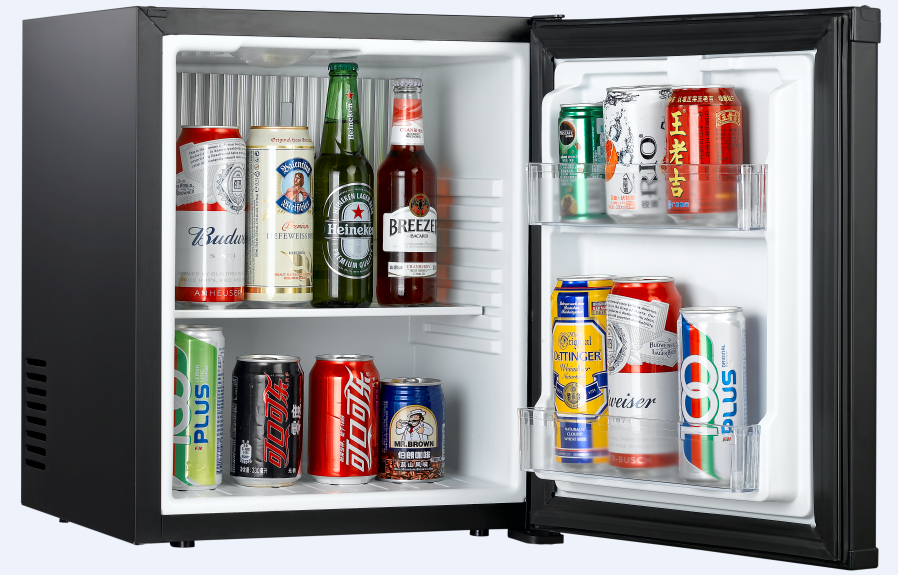
Visual merchandising drives minibar revenue. A glass door mini fridge invites impulse purchases by keeping premium beverages visible. Many properties utilize these units as an automated hotel beverage cooler. You can integrate infrared or weight sensors on the shelves for smart inventory tracking and automated billing.
This visibility introduces thermal insulation trade-offs. Glass panels, even double-glazed, transfer heat faster than solid polyurethane-injected doors. The heating element must work harder and longer to maintain internal temperatures, increasing energy consumption. In high-humidity environments, condensation can form on the exterior glass. Mitigation strategies include specifying units with low-E glass coatings or integrating low-wattage perimeter heaters to prevent moisture accumulation. You should also consider the lighting in the room; direct sunlight hitting a glass door will rapidly heat the interior, forcing the absorption system past its cooling capacity.
Solid door models offer superior thermal retention. The thick insulation reduces the operational load on the absorption system, lowering daily energy costs. These units integrate seamlessly into custom hotel cabinetry. Panel-ready options and sliding hinge mechanisms allow the fridge door to open simultaneously with the wooden cabinet door.
Solid configurations serve best as guest-use refrigerators. When properties pivot away from revenue-generating minibars toward providing empty fridges for guest personal items and medications, merchandising visibility becomes irrelevant. The solid door maximizes efficiency and maintains a clean, uniform aesthetic within the room design. We often install solid door units in extended-stay properties where guests prioritize functional storage over premium beverage displays. The robust door construction also withstands heavy use better than glass alternatives.
Absorption systems extract heat from the cabinet and release it through the rear condenser fins. Without adequate airflow, this heat accumulates, stalling the thermochemical cycle and causing the internal temperature to rise. Strict passive ventilation is mandatory for every installation.
Cabinet design must facilitate the chimney effect. Cool air must enter beneath the unit, pass over the rear fins, absorb the heat, and exit through the top. Standard engineering requirements dictate a minimum of 200 cm² (31 sq. in.) of unobstructed cross-sectional clearance for both the bottom air intake and the top air exhaust. The depth of the cabinet must also leave at least 2 inches of space between the wall and the cooling unit.
You can achieve this by routing air through a toe-kick grille at the base of the millwork. The air travels up a channel behind the refrigerator and exits through a routed grille in the countertop or a gap above the cabinet door. Never assume standard residential cabinetry will work without modification. You must work closely with your millwork provider to ensure these ventilation channels are built into the design from day one.
The most frequent cause of absorption fridge failure is improper cabinetry installation. Enclosing the unit without a top exhaust traps heat. This leads to system failure, overheating, and voided manufacturer warranties. The hot air must have a clear, unhindered path out of the enclosure.
Placing units adjacent to external heat sources, such as radiators or areas receiving direct afternoon sunlight, severely degrades cooling performance. Furthermore, absorption units must sit perfectly level. The internal cycle relies on gravity to return the liquid ammonia to the boiler. Inadequate leveling disrupts this flow, causing the refrigerant to pool in the tubing and halting the cooling process entirely.
Follow these steps to verify proper installation:
Measure the bottom intake grille to confirm it provides at least 200 cm² of open airflow space.
Inspect the rear clearance to ensure a minimum 2-inch gap exists between the condenser fins and the back wall.
Verify the top exhaust route is completely unobstructed and vents outside the cabinet enclosure.
Place a bubble level on top of the unit to confirm it is perfectly horizontal on both the X and Y axes.
Check the door swing to ensure the hinges do not bind against the custom millwork.
When evaluating procurement options, facility managers must look past the initial capital expenditure. Absorption units often carry a higher upfront price tag than basic compressor or semiconductor models. However, the lack of moving parts transforms the replacement cycle.
Mechanical compressors suffer from wear and tear on bearings, valves, and motor windings. Peltier modules degrade thermally. Absorption units frequently exceed 10 years of continuous operation. The extended operational lifespan significantly reduces the frequency of replacement purchasing, labor costs for swapping units, and disposal logistics. You spend less time managing broken appliances and more time focusing on preventative property maintenance.
Routine maintenance ensures longevity. Housekeeping and engineering staff must periodically dust the rear condenser fins. Accumulated dust acts as an insulator, trapping heat and reducing efficiency. Staff should also inspect door seals for air leaks and verify that the auto-defrost drainage tube remains clear of debris.
Safety protocols regarding ammonia-based coolants are strictly regulated. Commercial hospitality units use a very small, hermetically sealed volume of ammonia. The robust steel tubing prevents leaks under normal operating conditions. Properties must ensure units meet international safety and compliance standards for enclosed guest room use.
Implement these maintenance checks quarterly:
Vacuum the rear condenser fins to remove dust and lint buildup.
Perform the dollar bill test on the magnetic door gasket to ensure a tight seal.
Flush the defrost drain tube with warm water to prevent clogs and interior leaks.
Inspect the internal LED lighting and door switch mechanism for proper operation.
Verify the internal temperature using a calibrated digital thermometer.
Effective procurement requires rigorous vendor evaluation. You should verify warranty terms specifically for commercial hospitality use, as residential warranties often void upon hotel installation. Assess the vendor's support network for parts availability, including replacement hinges, magnetic door seals, and thermostats.
Logistics planning is critical for large properties. Evaluate bulk shipping capabilities, phased installation planning to match floor-by-floor renovations, and old unit recycling programs. Ensuring the vendor can handle the removal and environmentally compliant disposal of legacy refrigerators streamlines the upgrade process. You need a partner who understands the operational constraints of an active hotel environment.
Audit all existing guest room cabinetry to ensure a minimum of 200 cm² of unobstructed top and bottom airflow clearance.
Determine the exact ratio of solid door to glass door units needed based on your property's minibar merchandising strategy.
Implement a strict leveling protocol for your engineering team during the installation phase to ensure gravity-fed cooling cycles function correctly.
Initiate RFPs with vendors specializing in commercial hospitality cooling, demanding 10-year lifespan projections and commercial warranty terms.
A: Yes. Because they use a heat-driven chemical process rather than a mechanical compressor or fans, they produce 0dB of noise. This makes them ideal for hotel bedrooms, ensuring uninterrupted guest sleep and maximizing room acoustic design.
A: Both are compressor-free and quiet. Absorption uses a sealed liquid refrigerant cycle heated by an element. A semiconductor fridge uses solid-state electrical currents passed through dissimilar metals. Absorption generally offers better cooling performance and longevity in warmer rooms.
A: Yes. Glass door models are highly effective for merchandising minibar items and can be equipped with automated billing sensors. However, they require more energy to maintain internal temperatures compared to solid-door models due to lower insulation values.
A: Absorption units require strict passive ventilation to dissipate heat. Standard requirements typically include a minimum of 200 cm² (31 sq. in.) of unobstructed cross-section for both the air intake at the bottom and the exhaust at the top of the cabinet.
A: The most common causes are inadequate cabinet ventilation trapping heat, the unit not being perfectly level, or ambient room temperatures exceeding the unit's maximum operational threshold. Leveling is mandatory because the refrigerant flow relies entirely on gravity.
A: Yes. Commercial hospitality units use a very small, hermetically sealed amount of ammonia. They are rigorously tested to meet international safety and compliance standards for in-room use, posing no risk under normal operating conditions.