E-mail: sachikoo_sz@yeah.net
Telephone: +86-13118819569

Views: 0 Author: Site Editor Publish Time: 2026-06-02 Origin: Site


Seeing a 2,000-watt label on your countertop appliance might spark instant anxiety. You probably assume it drives your monthly utility bill through the roof. This fear stems from a widespread misunderstanding. Consumers frequently confuse momentary power draw—measured in Watts—with actual energy consumed over time, measured in kilowatt-hours (kWh). We need to clarify this important distinction today.
This guide provides a transparent, physics-based breakdown of boiling water. We evaluate how much energy a standard Electric Kettle truly demands. We compare various heating methods to reveal the most efficient option for your kitchen. You will discover verifiable strategies to minimize daily costs. We also explore how you can take your brewing off-grid seamlessly. Prepare to uncover why this everyday device remains completely misunderstood by most households.
An average electric kettle consumes approximately 0.1 to 0.125 kWh to boil 1 liter of water, costing only a few cents per use.
High-wattage kettles (e.g., 3,000W) do not consume more total energy than low-wattage ones (e.g., 1,500W)—they simply draw power for a shorter duration.
Electric kettles are highly efficient compared to microwaves and gas stoves due to direct heat transfer.
Neglecting maintenance (like letting limescale build up) can degrade heating efficiency by up to 35%.
Boiling only the water you need and utilizing temperature-control features can reduce energy usage by nearly 20%.
You cannot manage your home energy usage without understanding basic electricity terms. Many people struggle to differentiate between the speed of energy transfer and the total volume used. We must establish a clear calculation framework. This foundation helps you analyze any heating appliance accurately.
Watts measure the speed of energy flow. A high-wattage appliance pulls energy very quickly. However, utility companies do not bill you for speed. They bill you for volume. We measure this volume in kilowatt-hours (kWh). One kilowatt-hour equals 1,000 watts running continuously for one full hour. Your device might demand intense power, but it only runs for a few minutes. The total volume remains surprisingly low.
Heating liquids relies on absolute laws of physics. We must look at a concept called specific heat capacity. Water requires a massive amount of thermal energy to change temperature. Elevating one liter of water from standard room temperature to a rolling boil requires a fixed amount of energy. This process always takes approximately 100 watt-hours (0.1 kWh). You cannot cheat this scientific reality. The baseline energy requirement remains identical regardless of the appliance used.
You can calculate your exact daily usage easily. We use a simple plug-and-play formula. Follow these steps to find your true energy footprint:
Locate the wattage rating printed under your device base.
Divide your device wattage by 1,000 to find the kilowatts (kW).
Divide your boiling time in minutes by 60 to find the hours used.
Multiply the kilowatts by the hours to find your total kWh.
The mathematical equation looks like this: (Kettle Wattage / 1000) × (Minutes Used / 60) = Total kWh.
We can apply a localized cost calculation to see the financial impact. Imagine you boil one liter of water. Your device consumes 0.1 kWh. Your local utility rate is $0.15 per kWh. You simply multiply the two numbers. 0.1 kWh × $0.15 = $0.015. A single boil costs roughly one and a half cents. This micro-cost proves how economical direct heating truly is.
Appliance marketing often causes unnecessary panic. Manufacturers proudly display 3,000W stickers on premium models. Consumers immediately assume these high-power units waste electricity. This assumption represents the most common appliance misconception. We need to look at comparative data to understand the truth.
A 3,000W element boils liquid exactly twice as fast as a 1,500W element. The heavier power draw cuts the runtime in half. Time acts as the great equalizer here. Let us examine a direct mathematical comparison to prove this concept.
| Device Wattage | Time to Boil 1L | Formula Application | Total Energy Consumed |
|---|---|---|---|
| 1,500 Watts | 4 minutes | (1500/1000) × (4/60) | 0.1 kWh |
| 3,000 Watts | 2 minutes | (3000/1000) × (2/60) | 0.1 kWh |
The math reveals a perfect balance. The 3,000W model runs for just two minutes. The 1,500W model runs for four minutes. Both devices yield the exact same energy footprint of 0.1 kWh. You do not pay extra for speed. You simply compress the energy transfer into a shorter window.
Higher wattage does not increase your monthly utility bill. The total consumed volume remains constant. However, higher wattage does impact your electrical circuit's instantaneous load. A 3,000W draw might trip a sensitive breaker. This immediate load matters immensely for recreational vehicles or off-grid solar setups. Homeowners connected to a standard grid have nothing to fear. You can purchase the fastest model available safely.
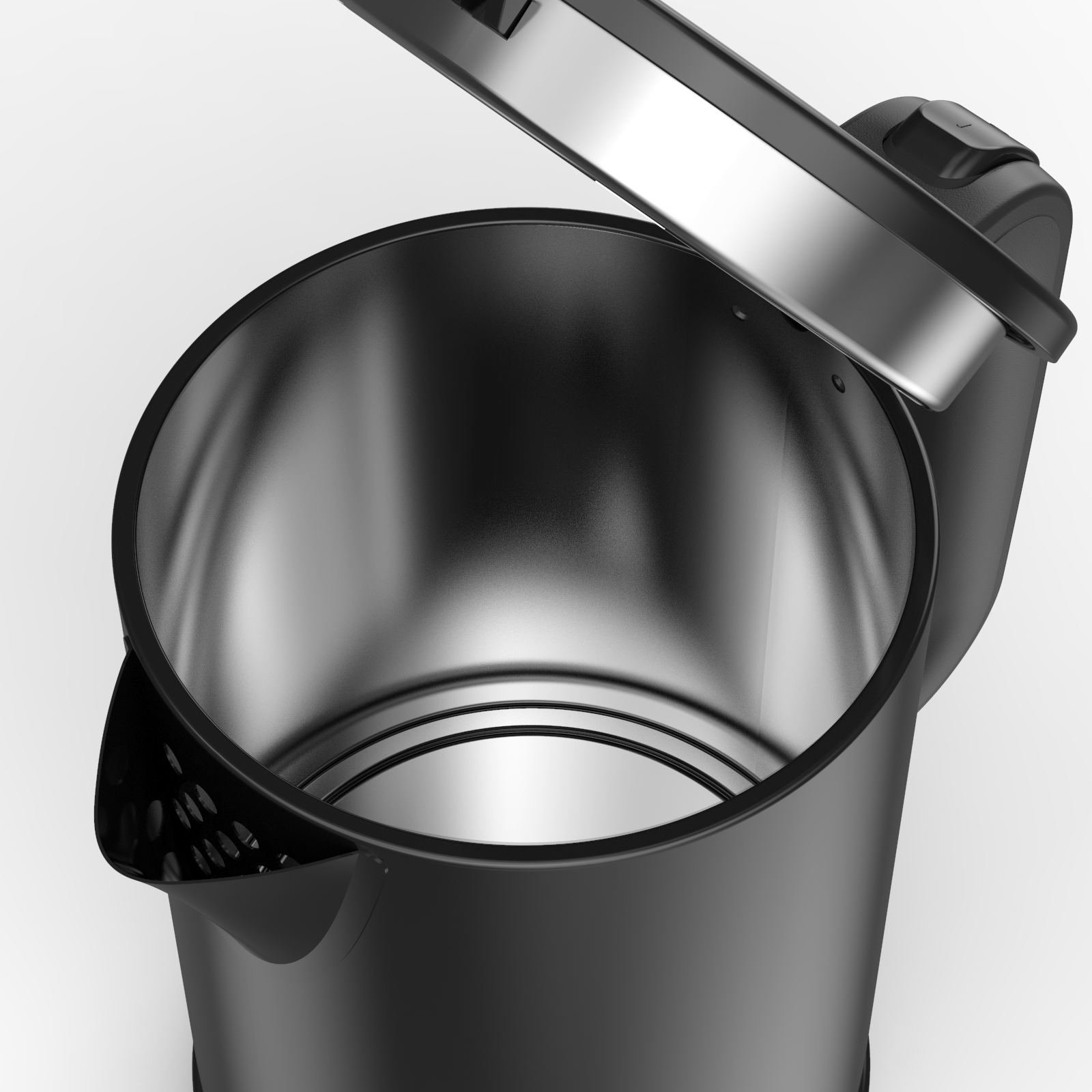
Consumers often wonder if boiling water on a stove saves money. You need an accurate decision-stage comparison to validate your choices. We must evaluate different appliances based on their thermal efficiency realities. Some methods waste massive amounts of heat into the surrounding air.
An internal submerged element offers unmatched heat transfer. The heating coil sits directly inside the water chamber. Nearly 100% of the generated thermal energy enters the liquid directly. The sealed container prevents ambient heat loss. In contrast, external methods force heat through barriers. Burners must heat pots. Pots then heat liquids. Every physical barrier creates a thermal loss point.
We can measure the exact energy required to boil one liter of water across various kitchen appliances. The following chart summarizes these physical test results.
| Heating Appliance | Energy Consumed (kWh) | Efficiency Characteristics |
|---|---|---|
| Electric Kettle | ~0.082 - 0.125 kWh | Fastest method. Near 100% direct heat transfer. Most efficient option. |
| Induction Cooktop | ~0.095 kWh | Highly efficient magnetic heating. Suffers minor loss through the pot material. |
| Gas Stove | ~0.125+ kWh | High ambient heat loss. Flames heat the surrounding kitchen air. Approx 35-40% less efficient. |
| Microwave Oven | ~0.140+ kWh | Least efficient. Prolonged runtime required. Converts electricity to microwaves inefficiently. |
The numbers speak clearly. Transitioning from stovetop boiling to a dedicated internal heating device is a verifiable micro-optimization. You stop paying to heat your kitchen air. You apply energy directly to your beverage. This small daily habit change cumulatively reduces your household energy footprint.
Your hardware might be highly efficient out of the box. However, daily user behavior heavily impacts actual performance. Poor maintenance and careless habits ruin energy optimization. We must address the implementation realities degrading your setup.
Many users blindly fill the reservoir to the maximum line. They often do this just to brew a single 250ml teacup. This common mistake wastes staggering amounts of energy. Boiling a full 1.7-liter pitcher for one drink wastes up to 80% of the consumed electricity. You heat liquid you never use. The hot water cools down eventually. The energy simply dissipates into the room. Always measure exactly what you intend to consume.
Hard water contains dissolved minerals. Boiling causes calcium carbonate to separate and cling to internal components. We call this crust limescale. Limescale acts as a powerful physical barrier against heat transfer. It literally insulates the heating coil from the surrounding liquid.
Light Scale (1-2mm): A thin chalky layer drops heating efficiency by approximately 8%. The element runs longer to penetrate the mineral wall.
Heavy Scale (5mm+): Thick rock-like deposits cause a massive 35% drop in heating efficiency. Your boil times increase dramatically. Your electric usage spikes accordingly.
Best Practice: Descale your reservoir monthly using equal parts white vinegar and water. Boil the mixture, let it sit, and rinse thoroughly. This simple maintenance preserves peak thermal transfer rates.
Modern smart home trends introduce a new problem. Premium models now feature LED screens, Wi-Fi connectivity, and constant temperature monitoring. These smart features require continuous baseline power. We call this phenomenon vampire draw. A plugged-in smart unit drains approximately 0.01 to 0.04 kWh daily. This waste occurs even when the device sits entirely idle.
Common Mistake: Leaving Wi-Fi enabled appliances plugged in before a long vacation. Always unplug smart appliances or use a physical power strip switch to eliminate this phantom drain.
Older mechanical models eventually fail. You will need to evaluate bottom-of-funnel purchasing criteria for a replacement. A well-chosen upgrade future-proofs your kitchen. It also ensures seamless integration into alternative energy setups.
Efficiency relies heavily on modern hardware features. Look for these two critical specifications when shopping:
Variable Temperature Control: Different beverages require different heat levels. Green tea and delicate coffees steep perfectly at 70°C to 80°C. A full 100°C rolling boil ruins their flavor. Stopping the heat cycle early saves 12% to 18% in total energy. Precision thermostats prevent unnecessary over-boiling.
Double-Wall Insulation: Premium models feature vacuum-sealed double walls. The exterior remains cool to the touch. The interior retains heat significantly longer. This insulation prevents the need to re-boil water if you step away from the kitchen momentarily.
Taking your brewing off-grid introduces complex technical challenges. Campers and homeowners experiencing power outages frequently face frustrating limitations.
The Off-Grid Challenge: Standard heating elements draw massive peak power. Even a compact unit routinely pulls over 2,000 watts instantly. This massive surge trips standard portable inverters immediately. Small solar generators automatically shut down to protect their internal circuitry from overload.
The Solution: You must size your backup battery appropriately. Do not rely on entry-level power banks. Recommend sizing a solar generator or home backup battery with at least a 2,500W to 3,000W continuous AC output capacity. Look for units advertising high surge protection. A robust inverter handles the initial resistive heating load seamlessly. This capacity ensures you can enjoy hot meals and beverages during prolonged grid failures or remote camping trips without triggering system errors.
An internal-element heating device remains one of the most energy-efficient appliances in the modern kitchen. Its direct heat transfer mechanism outperforms gas stoves and microwaves significantly. However, this inherent efficiency depends heavily on user behavior. You must operate the device correctly to realize the savings. Boiling precise water amounts prevents massive energy waste. Regular monthly descaling prevents mineral barriers from degrading thermal transfer. Unplugging smart models eliminates phantom power drain.
We highly recommend evaluating your current daily boiling habits. A simple shift in filling routines saves measurable electricity over a year. If achieving home energy independence ranks among your goals, pay close attention to appliance load ratings. Always ensure your backup portable power station is explicitly rated for high-wattage resistive heating loads before an emergency strikes.
A: People confuse momentary power with total energy. A heating element uses extreme power (often 2,000W+) but runs for only two to three minutes. A modern LED TV uses very low power (60-100W) but typically runs for several continuous hours. Over a full day, the TV almost always consumes more total energy (kWh) than boiling water twice.
A: The most efficient method requires a dedicated appliance featuring a concealed internal heating element. You must also combine this hardware with strict user habits. Boiling only the exact volume of water required for your immediate drink prevents thermal waste. Using variable temperature controls to stop short of 100°C for teas also increases efficiency.
A: Standard mechanical devices with a simple physical switch do not consume any electricity when turned off. However, modern smart models featuring digital screens, internal memory, or standby modes do draw phantom power. Unplugging them or utilizing a switched smart plug easily eliminates this minor daily energy waste.