E-mail: sachikoo_sz@yeah.net
Telephone: +86-13118819569

Views: 0 Author: Site Editor Publish Time: 2026-08-06 Origin: Site


Hotel bathrooms expose appliances to conditions that are very different from those in ordinary guest room areas.
Steam from showers raises the surrounding humidity. Condensation may form on walls and equipment surfaces. Housekeeping teams repeatedly clean appliances with detergents and disinfectants. Guests may operate a telephone, hair dryer, scale, or other device while their hands are damp.
These conditions make housing material selection an important part of hotel bathroom equipment procurement.
A housing must do more than look attractive. It should resist moisture, tolerate frequent cleaning, maintain its shape under changing temperatures, and protect internal components from normal bathroom conditions.
For equipment such as a Waterproof Hotel Telephone or wall-mounted hotel hair dryer, buyers should evaluate the complete product design rather than selecting a unit only because its outer shell is made from plastic.
ABS is commonly used for hotel telephone and hair dryer housings because it is lightweight, durable, and suitable for molded commercial products.
Polycarbonate may be selected when higher impact resistance or additional structural strength is required.
Stainless steel is more suitable for brackets, screws, mounting plates, and exposed hardware than untreated carbon steel.
The word “waterproof” should not be judged from housing material alone.
Seams, buttons, cable openings, mounting points, and internal protection also influence moisture resistance.
Hotel buyers should request supporting test information when a supplier claims a specific ingress-protection rating.
Bathroom equipment should be installed away from direct water spray unless it is specifically tested and approved for that location.
Material compatibility with hotel cleaning products should be confirmed before bulk purchasing.
Hotel bathroom appliances are used by many different guests over their service life. They are also cleaned more frequently than comparable residential products.
This creates several material-related risks.
A poor-quality plastic housing may gradually discolor, crack, soften, or lose its surface finish. Metal fasteners may develop rust. Printed service-button labels may fade after repeated cleaning. Gaps around buttons or cable entries may allow moisture to reach internal components.
These failures affect more than the appearance of the room.
A damaged hotel telephone may prevent a guest from contacting reception. A loose hair dryer bracket may increase maintenance requirements. A cracked appliance shell may cause the hotel to remove the room from service until the unit is inspected or replaced.
The correct housing material helps hotels improve:
Product durability
Guest safety
Cleaning efficiency
Bathroom appearance
Maintenance consistency
Replacement planning
Brand standards across multiple properties
For large hotel projects, even a small difference in product service life can significantly affect total replacement and maintenance costs.
The most suitable material depends on the product, its installation position, its operating temperature, and the amount of moisture it may encounter.
Acrylonitrile butadiene styrene, commonly known as ABS, is widely used for telephone, hair dryer, remote control, and small appliance housings.
ABS offers several practical advantages for hotel projects:
Good impact resistance
Relatively low product weight
Smooth molded surfaces
Flexible color options
Convenient logo and label customization
Stable shape during normal indoor use
Cost-effective production for large hotel orders
ABS is especially suitable for equipment that must combine a clean appearance with frequent daily operation.
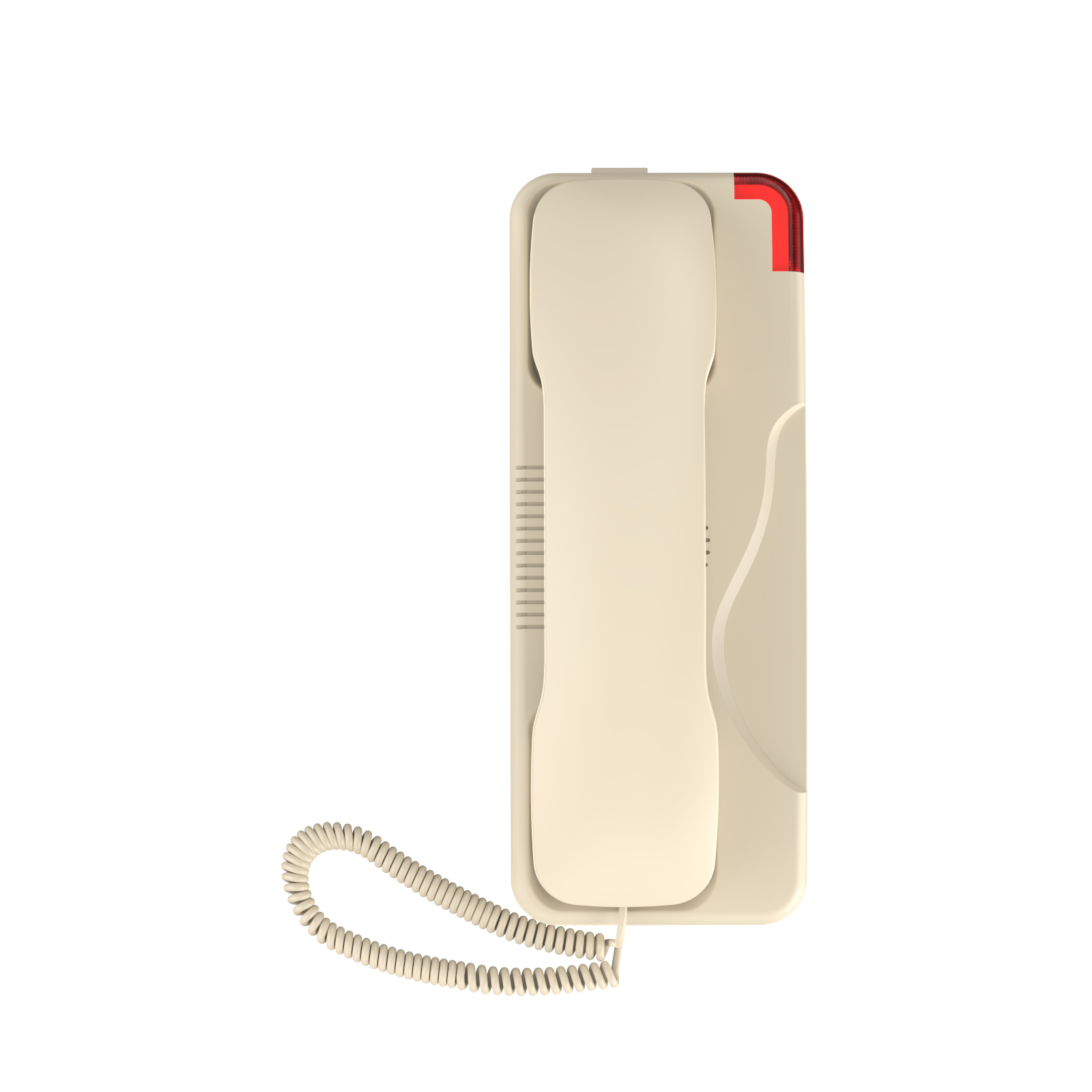
Sachikoo’s wall-mounted hotel bathroom telephone uses an ABS plastic case with an anti-oxidation and fade-resistant surface treatment. The model is designed for hotel bathrooms and includes wall mounting, hands-free operation, volume control, call indication, and programmable hotel service keys.
However, ABS alone does not make a product waterproof.
Its performance still depends on:
Housing thickness
Material grade
Joint design
Keypad structure
Cable-entry protection
Internal circuit protection
Mounting method
Product testing
A thin or poorly assembled ABS housing may perform less reliably than a properly engineered housing made from the same general material.
Polycarbonate is another material used for electrical and communication equipment housings.
Compared with standard ABS, polycarbonate can offer higher impact resistance and improved dimensional stability in demanding applications. It may be considered for equipment installed in high-traffic public bathrooms, elevators, pool facilities, spas, or other locations where accidental impact is more likely.
Its potential advantages include:
High impact strength
Good structural rigidity
Resistance to cracking
Suitability for transparent components
Stable performance across a wider temperature range
Polycarbonate is often more expensive than ABS. It may also require suitable surface treatment if appearance, scratch resistance, or chemical resistance is important.
Hotels do not necessarily need polycarbonate for every bathroom appliance. The decision should be based on the installation environment and the level of physical protection required.
Some appliance manufacturers use ABS-polycarbonate blends to combine the processing advantages of ABS with the impact strength of polycarbonate.
These materials may be suitable for:
Premium hotel bathroom equipment
High-use public washrooms
Wall-mounted communication devices
Hair dryer holders
Control panels
Equipment installed near transport or public areas
Buyers should still request information about the specific material grade rather than accepting a general claim such as “high-quality plastic.”
Stainless steel is commonly used for mounting brackets, screws, internal supports, faceplates, and exposed bathroom hardware.
It is particularly useful where components may experience:
Condensation
Frequent wiping
High humidity
Contact with wet hands
Long-term wall installation
Stainless steel should generally be preferred over untreated carbon steel in exposed hotel bathroom positions.
For coastal hotels, beach resorts, spa properties, and humid tropical markets, corrosion resistance requires additional attention. Salt in the surrounding air may accelerate deterioration of unsuitable metal components.
Hotel buyers should ask which metal is used for:
Wall-mounting screws
Brackets
Hair dryer holders
Telephone mounting plates
Battery covers
Hinges
Decorative trims
Internal fasteners
A durable plastic housing can still fail prematurely if its screws and mounting hardware rust.
Powder-coated steel is suitable for some hotel room products, particularly hotel safes and structural equipment installed in dry guest room areas.
It is generally not the first choice for exposed bathroom appliances unless the coating, edges, holes, and fasteners are specifically designed for humid conditions.
Hotel safes, for example, are normally installed in wardrobes, cabinets, or other dry guest room positions. They should not be relocated into a bathroom simply because the outer steel surface has a coating.
Sachikoo’s hotel safe range is designed for secure in-room storage of passports, cash, laptops, and other valuables, rather than installation in bathroom wet zones.
This illustrates an important hotel procurement principle: housing material must be matched with the intended room location.
Aluminum may be used for decorative panels, internal supports, brackets, or equipment trim.
Its advantages include:
Low weight
Good corrosion resistance
Clean metallic appearance
Suitability for modern hotel interiors
Untreated aluminum can still change appearance or react with aggressive cleaning chemicals. Anodized or otherwise protected surfaces may provide more consistent long-term performance.
Flexible materials such as silicone and rubber may be used around joints, buttons, cable entries, and mounting interfaces.
These components can help reduce moisture entry, but their effectiveness depends on product design and assembly quality.
Hotels should inspect whether:
Gaskets fit evenly
Cable openings are protected
Button membranes remain intact
Seams close tightly
Flexible parts resist cracking
Cleaning chemicals affect the material
A small damaged seal can reduce the protection provided by an otherwise durable housing.
Neither material is automatically the best choice for every hotel project.
| Selection Factor | ABS | Polycarbonate |
|---|---|---|
| General impact resistance | Good | Very good |
| Product weight | Low | Low to moderate |
| Molded appearance | Good | Good |
| Color customization | Convenient | Convenient |
| Typical cost | Lower | Higher |
| Suitable for hotel telephones | Yes | Yes |
| Suitable for hair dryer housings | Yes | Yes |
| High-abuse public locations | Moderate suitability | Stronger suitability |
| Waterproof by itself | No | No |
For most guest room applications, a properly designed ABS housing can provide a practical balance of durability, appearance, and procurement cost.
Polycarbonate may be preferable in public or high-impact locations. However, the complete enclosure design remains more important than the material name alone.
A Waterproof Hotel Telephone may be installed in a guest bathroom so that guests can contact reception, housekeeping, medical assistance, or emergency services.
Because this function may become important during an emergency, hotels should assess more than the outer housing.
The shell should maintain its structure and appearance in humid indoor conditions. It should not have obvious gaps, weak joints, or loosely fitted panels.
Wall mounting keeps the telephone away from wet countertops and reduces bathroom clutter.
The mounting structure should remain secure when guests lift and replace the handset repeatedly.
Sachikoo’s bathroom telephone is designed as a wall-mounted unit for hotel bathrooms and other commercial environments. Its published specifications include an ABS case, programmable service buttons, hands-free operation, volume adjustment, a call light, PBX compatibility options, and moisture-resistant construction.
Hotel bathroom telephones should be easy to operate.
Common direct-dial functions may include:
Front desk
Emergency assistance
Housekeeping
Concierge
Medical support
Hotel security
Too many buttons can make the device more difficult to understand, particularly for international guests.
Button labels and hotel logos should resist fading during normal cleaning.
The hotel should review a physical sample using the same detergents and cleaning procedures applied by housekeeping teams.
The handset should remain securely in place on the wall unit. The cord should be long enough for practical use without hanging excessively or creating unnecessary clutter.
Steam, ventilation fans, and running water can increase bathroom noise. The telephone should provide sufficient handset or hands-free volume for the intended room environment.
Hotels should confirm that the telephone is compatible with the property’s existing PBX or communication system before placing a bulk order.
An IP rating classifies the degree of protection an enclosure provides against the entry of solid objects and water. These classifications are covered by IEC 60529.
However, hotel buyers should not assume an IP rating based only on:
The product name
The appearance of the housing
The use of ABS plastic
A supplier’s general marketing description
The presence of a gasket
When a specific IP rating is required, buyers should ask for supporting documentation covering the complete product.
The test should apply to the assembled telephone, hair dryer, or other appliance—not only to the raw housing material.
It is also important to understand that a higher water-ingress rating does not automatically approve an electrical appliance for installation in every bathroom zone. Local electrical codes, hotel design standards, operating voltage, power connections, and mounting distance must still be reviewed.
Wall-mounted hair dryers are common in hotel bathrooms because they reduce countertop clutter, keep the appliance in a predictable location, and make it more difficult for the unit to be removed from the room.
Sachikoo describes its wall-mounted hotel hair dryers as space-saving bathroom products that can include automatic shutoff when returned to the holder.
Housing selection for a hotel hair dryer should consider:
The housing must tolerate the heat generated during normal operation without softening, deforming, or producing an unpleasant odor.
Guests may accidentally drop the handset portion or strike it against the wall-mounted holder.
The wall holder should remain secure after repeated removal and replacement of the dryer.
The point where the cable enters the dryer or wall base is a common stress location. It should resist bending and pulling during daily use.
Housekeeping staff should be able to wipe the outer surface without damaging labels, switches, or coatings.
Where provided, automatic shutoff can help stop operation when the dryer is returned to its holder. The hotel should test this function during sample approval.
Hotel housekeeping routines can be more demanding than household cleaning.
A housing may be exposed to:
Disinfectants
Alcohol-based cleaners
Descaling products
Glass cleaners
Detergents
Fragranced cleaning solutions
Repeated wet wiping
Some chemicals can cause plastic surfaces to fade, become brittle, develop fine cracks, or lose printed markings.
Hotels should conduct a basic compatibility test before approving a large order.
A practical test can include:
Obtain a finished production sample.
Use the property’s normal bathroom cleaning product.
Apply it according to the housekeeping procedure.
Repeat the process over multiple cleaning cycles.
Inspect the housing, labels, buttons, seams, and surface gloss.
Confirm that the appliance still operates normally.
Cleaning products should generally be applied to a cloth rather than sprayed directly into telephone buttons, ventilation openings, power connections, or appliance joints.
Even a well-designed housing can perform poorly if it is installed incorrectly.
Hotels should check the following installation details.
Whenever possible, telephones, hair dryers, scales, sockets, and other appliances should be positioned away from direct shower spray, bathtub splash, and areas where water commonly collects.
The wall should provide a stable mounting surface. Loose tiles, thin decorative panels, or poorly anchored fixtures can cause movement over time.
Cable entry points should be neat and protected. Large unsealed wall openings may allow moisture to reach connections behind the equipment.
Fasteners should be suitable for the wall material and humid environment.
Bathroom ventilation helps reduce prolonged condensation on appliances and wall surfaces.
Engineering staff should be able to inspect, remove, and replace the appliance without damaging surrounding tiles or finishes.
Before purchasing bathroom appliances, hotel owners, contractors, and purchasing companies should confirm:
What housing material is used?
Is the material grade identified?
Are exposed screws and brackets corrosion resistant?
Has the complete product been tested for moisture exposure?
Is a specific IP rating claimed?
Is supporting documentation available?
Is the product intended for a bathroom or only a dry guest room?
Can it tolerate the hotel’s cleaning products?
Are buttons and labels resistant to frequent wiping?
Is the product compatible with the hotel’s electrical or PBX system?
Is wall mounting hardware included?
Can colors and logos be customized?
Are replacement components available?
Has a physical sample been tested in a completed guest room?
Are local bathroom electrical requirements satisfied?
Budget hotels often prioritize simple operation, standardized installation, and manageable replacement costs.
Durable ABS housings can be appropriate when the product is properly designed and installed away from direct water exposure.
Luxury properties may place greater emphasis on surface finish, customized colors, discreet branding, and integration with the bathroom design.
The housing should maintain a premium appearance after repeated cleaning.
Resorts may experience higher humidity and, in coastal locations, salt in the surrounding air.
Corrosion-resistant fasteners, mounting brackets, and internal hardware require particular attention.
Business hotels generally require consistent equipment across many similar rooms.
Procurement teams should prioritize standardized dimensions, reliable PBX compatibility, easy housekeeping, and simplified spare-parts management.
Serviced apartments may have longer guest stays and more frequent appliance operation.
Housing durability, cord strength, replacement availability, and simple user controls become especially important.
The best housing material for a humid hotel bathroom depends on the equipment and its installation environment.
ABS is a practical option for many hotel telephones and hair dryers because it supports durable, lightweight, and customizable housings. Polycarbonate can provide additional impact resistance for demanding locations. Stainless steel and corrosion-resistant metals are more suitable for brackets, screws, and exposed structural parts.
However, material selection alone does not determine bathroom suitability.
Hotels must also examine:
Housing seams
Button construction
Cable openings
Mounting hardware
Internal component protection
Cleaning resistance
Electrical requirements
Installation position
Supporting test documentation
A Waterproof Hotel Telephone should therefore be evaluated as a complete hotel communication product rather than as a simple plastic enclosure.
Sachikoo supplies hotel telephones, wall-mounted hair dryers, hotel safes, minibar refrigerators, electric kettle sets, scales, emergency flashlights, and other hotel room appliances. Hotel buyers can discuss housing materials, functions, branding, colors, packaging, and OEM or ODM requirements according to the needs of their property or hotel project.
ABS plastic is commonly used because it is lightweight, durable, easy to mold, and suitable for customized hotel telephone housings. The complete enclosure design must still be assessed for moisture resistance.
No. ABS is only the outer material. Moisture resistance also depends on housing seams, button membranes, cable entries, internal protection, installation, and product testing.
Polycarbonate generally offers higher impact resistance, but it is often more expensive. A properly designed ABS housing can be suitable for standard hotel guest bathrooms.
Corrosion-resistant stainless steel is commonly preferred for exposed screws, brackets, and mounting components. The correct grade depends on the environment, especially in coastal or high-humidity hotels.
Only when the product is designed and approved for the intended bathroom environment. A normal desktop hotel telephone should not automatically be treated as a bathroom telephone.
It should be positioned where guests can reach it easily while remaining away from direct shower spray, bathtub splash, and standing water. Local accessibility and electrical requirements should also be reviewed.
Hotels should request documentation showing that the complete assembled product was tested according to the stated ingress-protection standard.
They save space, maintain a consistent installation position, reduce countertop clutter, and can include hotel-oriented features such as a fixed holder and automatic shutoff.
Use a production sample and repeatedly clean it with the property’s normal housekeeping products. Inspect the surface, labels, buttons, joints, and product operation after testing.
Generally, no. Hotel safes are normally intended for dry guest room positions such as wardrobes or cabinets. Their installation location should follow the manufacturer’s instructions.